Private Website PreviewPrepared exclusively for Discovering Minds Montessori School

No Expiry

Claim now

Registration is open year round — places are limited

A Montessori classroom is not organised by birthday. Each room holds a three-year age span, and a child moves through it as a three-year unit with a beginning, a middle and an end. The third year is the capstone — academically, socially and emotionally — and it is the year the previous two were paying into.

You have poured the concrete. It still needs time to set. How Montessori teachers describe the third year

A child who leaves at the end of year two has done the work without collecting the return on it. They will have learned a great deal. What they will not have had is the year in which it comes together, gets consolidated by being taught to somebody smaller, and turns into confidence.

Year by year

What actually changes across the three years

Every child is different and moves at their own pace. A five-year-old in their first year is doing quite different work from a five-year-old in their third — which is exactly the point.

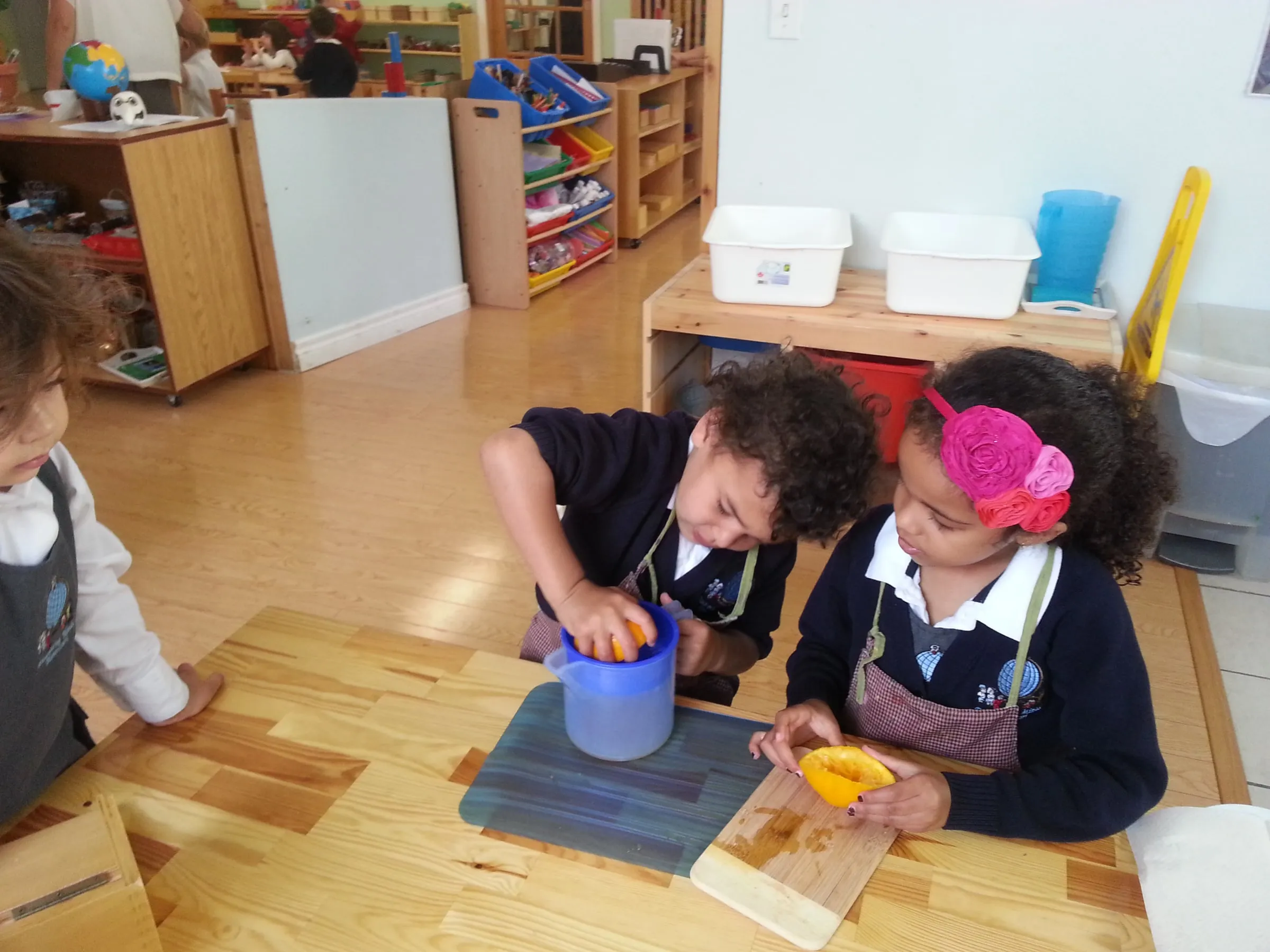
Young children squeezing oranges at a classroom table
01

First year

From 28 months, to about 3.5

  • Learns to control and coordinate movement through practical life work — pouring, sweeping, dressing frames, buttons.
  • Builds the capacity to concentrate, which is the real prerequisite for later mathematics and language.
  • Discovers what it means to belong to a community larger than the family: following rules, respecting other people’s work.
  • Spends a great deal of time simply watching older children work. This is not idleness; it is how the room teaches.
  • Sorts sensorial impressions — colour, shape, texture, sound — creating the mental order everything later is built on.
  • Begins vocabulary work, hearing sounds inside words, and tracing the sandpaper letters. Some children begin numbers one to ten.
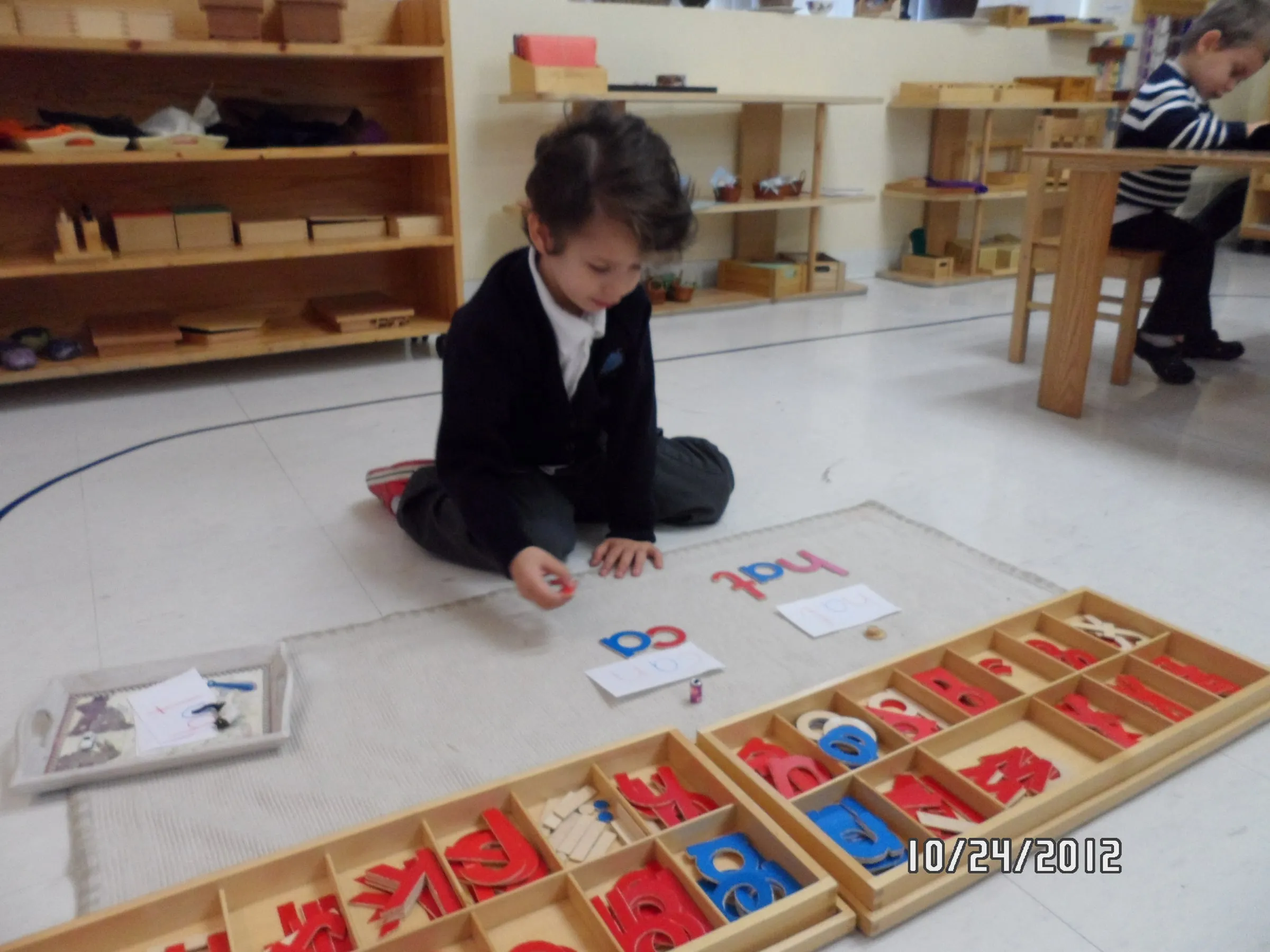
A child building words on the floor with the movable alphabet
02

Second year

From about 3.5 to 4.5

  • Practical life gets harder and longer: washing linens, polishing silver, tying bows.
  • Refines the senses by grading materials and moving on to the advanced sensorial work.
  • Starts building words with the movable alphabet, and works the metal insets to gain pencil control.
  • Consolidates numbers to ten, then counts on towards a thousand.
  • Meets the decimal system and the four operations for the first time, in concrete form.
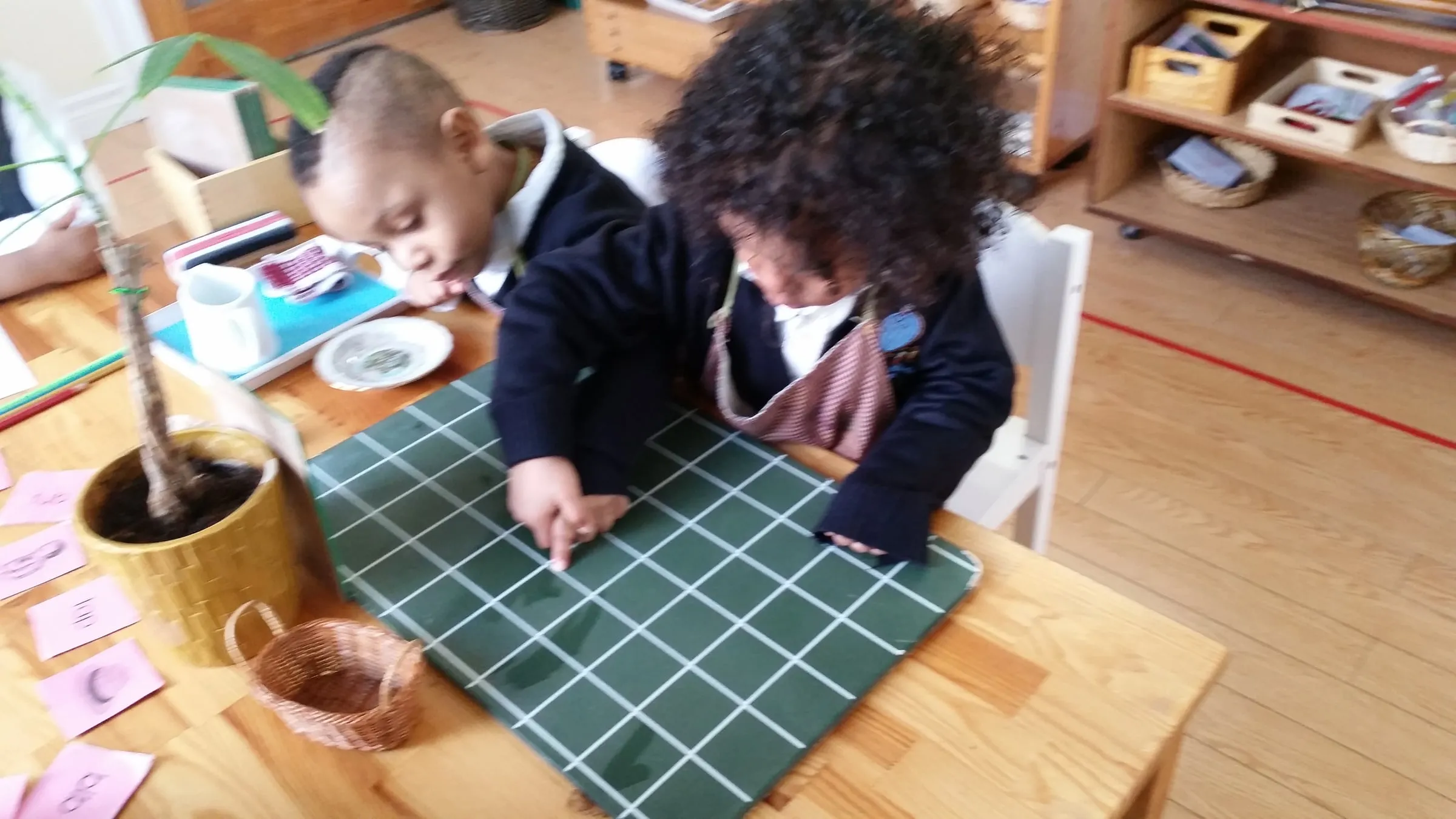
Two children working on the hundred board together
03

Third year

The capstone, roughly 4.5 to 6

  • Everything from the previous two years converges — and this is the year the joy shows.
  • Reads: first phonetically, then phonograms and sight words, then fluently. Sentence analysis begins.
  • Carries out four-digit addition, subtraction, multiplication and division with the decimal system.
  • Explores single-digit equations, and begins memorising them almost as a by-product.
  • Gives lessons to younger children, cares for the classroom, and carries real responsibility.
  • Leaves with curiosity, self-confidence, and a foundation for enjoying learning for its own sake.

The deeper reason

Why the oldest child in the room is the one who gains most

Dr. Montessori described human growth from birth to twenty-four as four “planes of development”: birth to six, six to twelve, twelve to eighteen, eighteen to twenty-four. Each plane has its own needs and characteristics, which rise and then fade across roughly six years. She then built methodology and materials to answer the needs of each.

Conventional schooling tends to make a child in a transitional year the youngest in a new group. Montessori does the opposite: it makes them the oldest and most mature in a group they already know, and gives them age-appropriate responsibility inside it. They become the educational and civic leaders of a small community.

The effect on the room is considerable. The effect on the child is larger. Standing tall through an uncertain year, while quietly internalising two years of academic work by explaining it to somebody younger, does something that no amount of additional instruction achieves.

You do not understand something until you can teach it

Giving a lesson to a younger child forces the older one to reduce a complex idea to its simplest parts and convey it clearly. If they cannot, it is immediately obvious — to them, and to their teacher — that they need another lesson before moving on. Without ever quite realising what they are doing, third-year children consolidate and cement two years of skill before exploding into the next cycle.

And the practical argument

Kindergarteners have far more in common with three- and four-year-olds than with eight- and nine-year-olds. Grouping them accordingly is not sentimentality; it is a reasonable reading of how children of that age actually relate to one another.

The cost of leaving early is not only borne by the child who leaves. The younger ones lose the leadership, mentoring and instruction of the older children they were coming to admire.

In practice, at Discovering Minds

Two cycles, one school

Casa runs as one cycle, from 28 months through Senior Kindergarten. Lower Elementary runs as the next. Both are taught under the same roof, so a child can complete two full cycles without ever changing schools — which is unusual in downtown Toronto and is the main reason families stay. Consolidating into one building makes that more true, not less.

Be first through the door

We are moving to one new downtown location for the 2026-27 school year. Call us or send a note now and you will be among the first families offered a tour when the doors open.

Private Preview

Claim this website

This preview was designed and built for Discovering Minds Montessori School by Luke at StromTek Inc. — send a note to say you would like to keep it, and we will take it from there.

Luke · StromTek Inc.[email protected]