
Our approach
A day at Discovering Minds
Care runs from 7:30 in the morning until 5:00 at night, and the shape of it barely changes from one day to the next. Young children need that predictability more than they need variety.
The rhythm
From 7:30 to 5:00
- 7:30 – 8:30
Early arrival
Extended care for families who need an early start.
- 8:30 – 9:00
Supervised arrival
Children come in through the front door, where a teacher welcomes them.
- 9:00 – 12:00
Montessori work period
The heart of the day: a long, uninterrupted three-hour block in which children choose and pursue their own work.
- 12:00 – 12:30
Lunch
Brought from home. Children set the table, serve themselves and clear away.
- 12:30 – 1:30
Outdoor time
Weather permitting. Parks nearby, walks, and outdoor activity.
- 1:30 – 3:00
Afternoon work period
A second work block, which is where French and Spanish are taught. Rest time for the youngest children.
- 3:00 – 3:30
Snack and preparation
Supervised snack, tidying the classroom, and getting ready to go home.
- 3:30 – 5:00
Late care
Quiet work, reading and free choice until pick-up.
The three-hour block
Why the morning is left alone
The 9:00 to 12:00 work period is the part of the day we protect hardest. Concentration in a young child takes a long time to build and about four seconds to destroy, so we do not schedule anything through it — no assemblies, no rotations, no bells. Children choose their work, carry it to a mat or a table, finish it, and put it back where it belongs.
Lunch comes from home
We do not provide food. Children bring lunch and snacks, and eat together at low tables — setting places, serving themselves, and clearing away afterwards, which is practical life work in its own right.
The school is nut-free
No nuts, peanuts or products containing them, anywhere in the building. We also ask families to leave pork out of lunchboxes, which keeps one fewer thing to think about for the families here who avoid it.
Allergies and medical needs
Tell us at registration. We will send the forms your doctor needs to sign, and it is the family’s job to keep EpiPens current and to let us know when anything changes.
Outdoor time, every day
Weather permitting, children go out daily — to the parks around the corner or on a walk through the neighbourhood. Older children also go further afield, on foot or by TTC.
Rest for the youngest
Children who need to sleep do so in the early afternoon. Bring a blanket, a pillow with a case and a set of small sheets, labelled. Bedding goes home on Friday to be washed and comes back Monday.
Uniform, every day
Grey slacks or a knee-length skirt, a white collared top with the school logo, school cardigans and jackets, and indoor shoes kept at school. Keep a spare set here — accidents happen.
Beyond the classroom
The neighbourhood is part of the curriculum
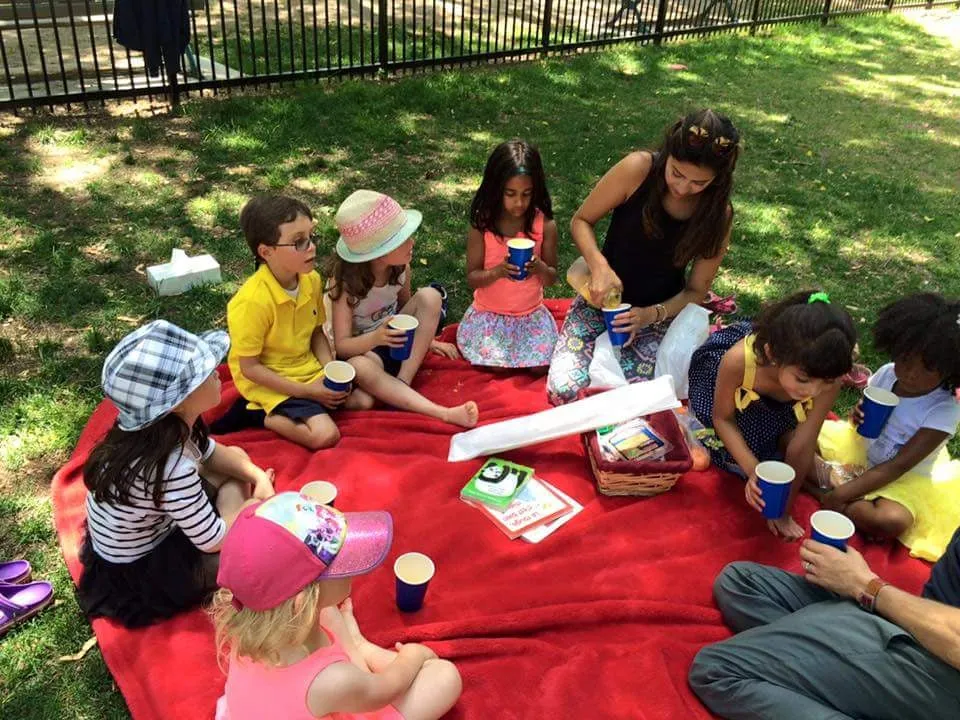
Children go outside every day the weather allows — to the parks nearby, or simply for a walk. It is scheduled, not conditional on good behaviour.
Through the year, classes also go further: historic sites, museums, art galleries, the library, and the local shops and cafés — for scientific observation as much as for social development. We travel on foot or by public transport. Visitors come to us too, for music, drama, art and fitness workshops.
Where a trip needs anything special — a packed lunch, an admission fee, a hired coach — we send a separate permission form well in advance.
See an ordinary morning
We would rather show you a normal Tuesday than stage an open house — so tours start again when our new building opens, between 9:00 and 11:00, with the work period running. Ask now to be offered one of the first.